Measuring angles for roof trusses might sound tricky, but it doesn’t have to be. If you want your roof to be strong and fit perfectly, getting those angles right is key.
In this guide, you’ll learn simple, step-by-step methods to measure angles accurately—even if you’re new to construction. By the end, you’ll have the confidence to tackle your roofing project with precision and avoid costly mistakes. Ready to master this essential skill?
Let’s dive in.
Tools Needed
Measuring angles for roof trusses needs the right tools. These tools help you get exact measurements.
Using the right equipment makes building safer and easier. Here are the tools you need.
Measuring Tape
A measuring tape is a basic tool to measure lengths and distances. It helps you find the sides of the truss.
Choose a tape that is long and sturdy. It should have clear marks for accuracy.
Protractor And Angle Finder
A protractor measures angles directly. It shows how many degrees an angle has.
An angle finder is a tool that helps measure tricky roof angles. It can be easier to use on large pieces.
- Protractor: good for small, precise angles
- Angle finder: better for bigger or odd angles
Framing Square
A framing square helps check right angles on roof trusses. It is shaped like an L and is very useful.
This tool helps you mark straight lines and measure 90-degree angles easily. It is strong and easy to use.
Calculator And Pencil
A calculator helps do math for angle measurements. It is useful for finding unknown angles or lengths.
A pencil is needed to mark your measurements and notes on wood or paper. Use a sharp pencil for clear marks.
Basic Roof Truss Angles
Measuring angles for roof trusses is key in building a strong roof. These angles affect how the roof holds weight and sheds water.
Understanding basic roof truss angles helps in cutting wood correctly and assembling the truss with accuracy.
Common Angle Types
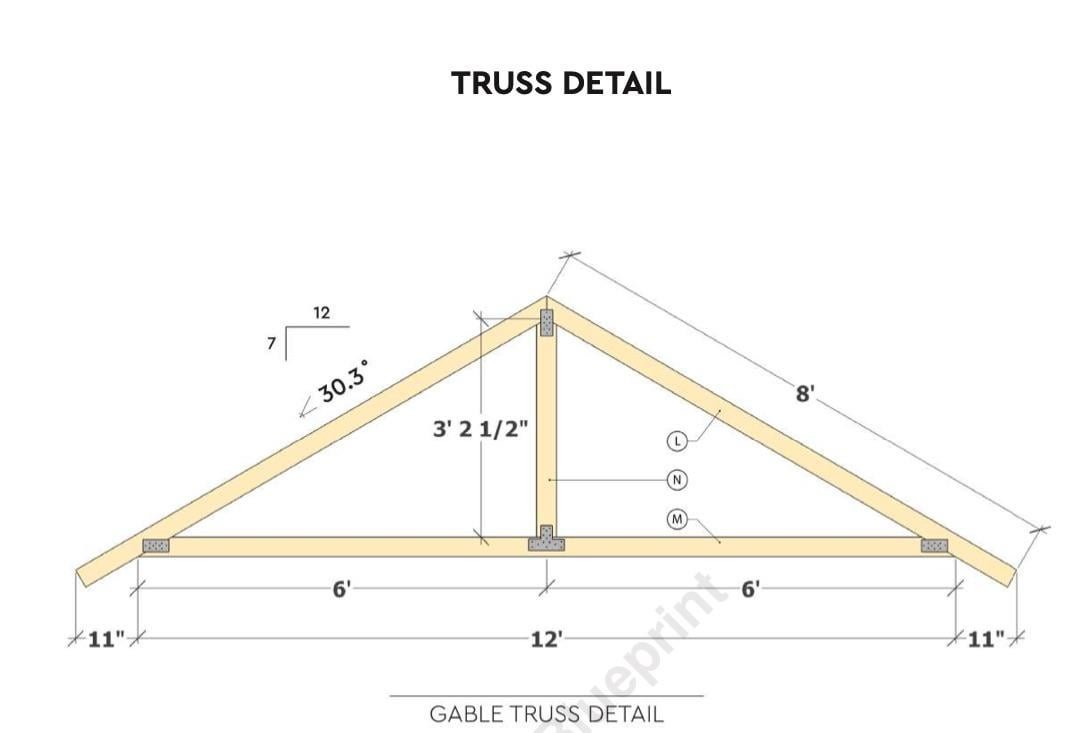
Roof trusses use several common angle types. These include the top chord angle, bottom chord angle, and web member angles.
- Top Chord Angle:The angle where the upper beams meet at the roof peak.
- Bottom Chord Angle:The angle of the horizontal beam forming the base of the truss.
- Web Member Angles:Angles between the internal support beams connecting top and bottom chords.
Knowing these angles helps in marking and cutting wood precisely for the truss structure.
Pitch And Slope Concepts
Pitch and slope describe how steep a roof is. Both use angles but in different ways.
| Term | Description | Example |
| Pitch | Ratio of rise over run, often shown as “4 in 12” | Roof rises 4 inches for every 12 inches horizontally |
| Slope | Angle of the roof measured in degrees | Roof angle of 18.4 degrees |
Pitch helps carpenters plan cuts using simple ratios. Slope gives a clear angle for measuring tools.
Step-by-step Measuring Process
Measuring angles for roof trusses is essential for proper construction. Accurate angles ensure a strong and stable roof.
This guide will help you measure angles correctly with simple steps and tools. Follow each part carefully to avoid mistakes.
Preparing The Workspace
Start by clearing the area where you will work. Make sure you have enough light and space to move around safely.
Gather all tools you need, such as a protractor, pencil, measuring tape, and a straight edge. Keep them within reach.
Marking Reference Points
Identify the points where you will measure the angle on the truss. These points help you place the protractor correctly.
Use a pencil to mark these points clearly. Double-check the marks before moving on to measuring.
- Mark the vertex where two beams meet
- Mark the ends of each beam forming the angle
- Ensure marks are visible and accurate
Using The Protractor Correctly
Place the protractor’s center hole on the vertex mark. Align one beam with the zero line on the protractor.
Read the number where the second beam crosses the protractor scale. This number is the angle between the beams.
- Keep the protractor steady to avoid errors
- Use the inner or outer scale depending on the angle
- Write down the angle measurement immediately
Verifying Measurements
Check your angle by measuring it again. Take at least two readings to confirm accuracy.
If measurements differ, re-measure carefully. Consistent results ensure correct roof truss assembly.
- Compare readings for consistency
- Use a different protractor if needed
- Ask someone to help check measurements
Credit: www.diychatroom.com
Calculating Angles From Measurements
Measuring angles for roof trusses is important for building a strong roof. You can find angles by using basic measurements and simple math. This helps make sure the trusses fit together well.
Angles tell you how steep or flat the roof is. Knowing the angles helps cut wood pieces correctly and build safer roofs.
Using Trigonometry Basics
Trigonometry uses triangles to find angles and lengths. You only need to know two sides of a right triangle to find the angle.
For roof trusses, the common functions are sine, cosine, and tangent. Tangent is most useful because it uses the opposite and adjacent sides.
- Measure the rise (vertical height) of the truss.
- Measure the run (horizontal length) of the truss.
- Use tangent: angle = arctan(rise ÷ run).
- Use a calculator to find the arctan value in degrees.
Converting Pitch To Degrees
Roof pitch is the ratio of rise over run. It shows how steep the roof is. Pitch is often written as “X in 12”, meaning X inches of rise for every 12 inches of run.
You can convert pitch to degrees using a simple formula. This helps if you only know the pitch and want the angle.
- Identify the pitch (rise per 12 inches of run).
- Use the formula: angle = arctan(pitch ÷ 12).
- Calculate the angle using a calculator set to degrees.
Tips For Accuracy
Measuring angles for roof trusses needs care and precision. Accurate angles ensure strong and safe roofs.
Using the right tools and methods helps you get the correct measurements every time.
Double-checking Angles
Always measure angles more than once to avoid mistakes. Check from different points if possible.
Use a protractor or angle finder twice and compare results. This confirms your measurements are correct.
Avoiding Common Mistakes
Keep the measuring tool steady and aligned with the roof edges. Slipping tools cause wrong angles.
- Do not guess angles without tools
- Measure on flat surfaces only
- Make sure tools are clean and not damaged
- Avoid measuring in poor light
Using Digital Tools
Digital angle finders give quick and accurate readings. They reduce human error in measurements.
Use smartphone apps with built-in levels for easy angle checks. Calibrate the app before use for best results.

Credit: www.reddit.com
Safety Considerations
Measuring angles for roof trusses requires careful attention to safety. Working safely helps prevent accidents and injuries.
Before starting, understand the risks and use proper safety gear. Follow rules to protect yourself and others on site.
Working At Heights
Working on roofs or ladders is dangerous. You must use safety harnesses and guardrails to avoid falls. Always check your equipment before use.
- Wear a helmet to protect your head
- Use non-slip shoes to keep steady
- Secure ladders on solid ground
- Use fall arrest systems when working above 6 feet
- Never work alone at height
Proper Handling Of Tools
Handling tools correctly reduces the risk of injury and damage. Inspect tools before use and keep them in good condition.
| Tool | Safety Tip | Common Hazard |
| Measuring Tape | Retract slowly to avoid cuts | Snap-back injuries |
| Protractor | Handle with care to prevent breakage | Sharp edges |
| Chalk Line | Keep line taut and away from eyes | Eye injury from snapping line |
| Hand Saw | Use gloves and cut away from body | Cuts and splinters |

Credit: www.wikihow.com
Frequently Asked Questions
How Do You Measure Roof Truss Angles Accurately?
To measure roof truss angles accurately, use a protractor or angle finder. Ensure the tool is aligned properly with the truss edges. Double-check measurements for precision. Accurate angles help in cutting and assembling trusses correctly.
What Tools Are Best For Measuring Roof Truss Angles?
The best tools for measuring roof truss angles are a digital angle finder, carpenter’s square, or protractor. These tools provide precise readings and ease of use. Choose based on the complexity and size of your truss project.
Why Is Angle Measurement Important For Roof Trusses?
Angle measurement is crucial for roof trusses to ensure structural stability and proper fit. Incorrect angles can lead to weak joints and roof failure. Accurate angles guarantee the trusses support the roof load effectively.
Can I Measure Roof Truss Angles Without Specialized Tools?
Yes, you can measure roof truss angles without specialized tools by using a speed square and a tape measure. This method is less precise but can work for simple projects. Always verify measurements to avoid errors.
Conclusion
Measuring angles for roof trusses is crucial for a strong structure. Accurate measurements prevent future issues. Use basic tools like a protractor or angle finder. Practice makes the process easier and faster. Double-check measurements for precision. A solid roof truss ensures safety and durability.
Proper angle measurement saves time and money. Remember, small mistakes can lead to big problems. Stay patient and focused. With the right approach, anyone can measure angles effectively. Your roof project will benefit from careful planning and execution. Keep learning and improving your skills.
Happy building!