Are you feeling puzzled by angles and protractors? You’re not alone.
Whether you’re a student tackling geometry homework or someone diving into a DIY project, measuring angles accurately is key. With a simple tool like a protractor, you can unlock the secrets of precision. Imagine the satisfaction of knowing your work is spot on, every single time.
You’ll discover easy tips that make using a protractor a breeze. Get ready to feel confident and in control as you measure angles like a pro. Read on, and let’s transform your measuring skills together!

Credit: www.youtube.com
Choosing The Right Protractor
Measuring angles accurately needs the right protractor. Picking a good one helps make your work easier and more precise.
This guide explains what to look for when choosing a protractor. It covers types, materials, and size options.
Types Of Protractors
There are several types of protractors. Each fits different tasks and skills.
- Semi-Circular:Most common, measures angles up to 180 degrees.
- Circular:Can measure full 360-degree angles, good for advanced use.
- Bevel:Adjustable arms for measuring and marking angles directly.
- Digital:Shows angle readings on a screen for easy reading.
Material And Durability
Protractors come in different materials. The choice affects how long they last and how easy they are to use.
| Material | Durability | Use |
| Plastic | Light, can break easily | Good for school and light use |
| Metal | Strong and long-lasting | Best for heavy or professional use |
| Wood | Moderate, can warp | Used in crafts and traditional settings |
Size And Scale
Size and scale affect how easy it is to read and use the protractor.
- Larger protractors have bigger numbers and marks. They are easier to read.
- Smaller protractors are portable but may be harder to read.
- Check the scale units: some show degrees only, others include radians.
- Choose a size that fits your project and comfort.
Preparing For Measurement
Measuring angles accurately starts with good preparation. You need to set up your protractor carefully before taking any readings.
These tips will help you position the protractor correctly, align it well, and keep it steady during measurement.
Positioning The Protractor
Place the protractor flat on the surface where you want to measure the angle. Make sure the curved edge faces the angle’s vertex. Position it so you can clearly see both rays of the angle.
- Lay the protractor flat without tilting
- Center the hole or midpoint over the angle’s vertex
- Ensure the protractor covers both sides of the angle
Aligning The Baseline
The baseline of the protractor must line up exactly with one side of the angle. This side is your reference ray. Proper alignment ensures the measurement starts from zero degrees.
| Step | Action |
| 1 | Place the baseline along the reference ray |
| 2 | Check that the zero mark matches the ray’s edge |
| 3 | Adjust until the baseline does not tilt |
Ensuring Stability
Keep the protractor steady to avoid errors. Use your fingers to hold it gently but firmly. Avoid moving the paper or protractor while reading the angle.
- Hold the protractor at the edges only
- Use a flat, hard surface to prevent slipping
- Keep your hand steady and relaxed
Measuring Angles Accurately
Using a protractor helps measure angles in math and science. It is important to measure angles correctly to get precise results.
Learning how to read the scales and place the protractor properly will improve your accuracy.
Reading The Inner And Outer Scales
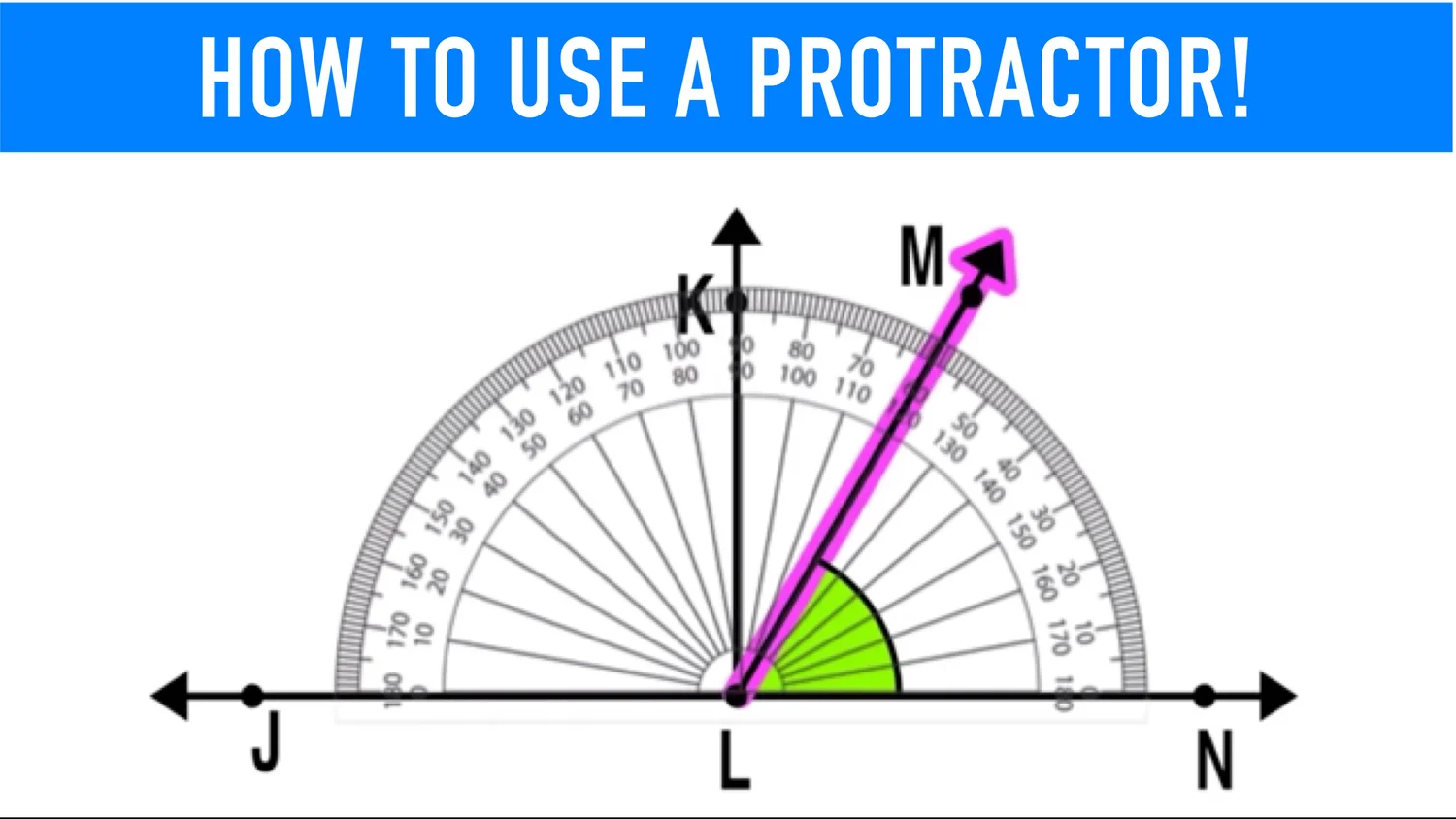
Most protractors have two sets of numbers: the inner scale and the outer scale. These scales measure angles in degrees from 0 to 180.
Choose the scale that starts from zero at the side where the first ray of the angle lies. This helps you read the correct angle measure.
- If the first ray points to the right, use the outer scale.
- If the first ray points to the left, use the inner scale.
- Check which scale starts at zero near the vertex line.
Identifying The Vertex
The vertex is the point where the two rays of the angle meet. Place the center hole of the protractor exactly on this point.
Align the baseline of the protractor with one ray of the angle. This setup helps you measure the angle correctly.
- Find the exact point where the two lines meet.
- Place the protractor’s center hole on this vertex.
- Line up the zero mark with one ray of the angle.
Avoiding Common Mistakes
Many errors happen when the protractor is not placed correctly or the wrong scale is read. Being careful helps avoid these mistakes.
- Don’t place the protractor off the vertex point.
- Check which scale you are reading before noting the number.
- Make sure the baseline aligns perfectly with one ray.
- Read the number closest to the second ray of the angle.
- Take your time to avoid rushing and misreading.
Advanced Techniques
Measuring angles with a protractor can be simple. Some situations need extra skills to get exact results.
These advanced tips help you measure tricky angles with more confidence and accuracy.
Using A Digital Protractor
A digital protractor shows angle readings on a screen. It is easier to read than a manual one.
Place the digital protractor flat on the surface. Then, adjust the arms to match the angle. The screen shows the exact degree.
- Turn on the device before use
- Calibrate it if needed for accuracy
- Hold it steady while measuring
- Read the number directly on the display
Measuring Reflex Angles
Reflex angles are larger than 180 degrees but less than 360 degrees. They can be hard to measure with a regular protractor.
To measure a reflex angle, first find the smaller angle inside it. Then subtract this from 360 degrees to get the reflex angle.
- Place the protractor to measure the smaller angle
- Note the measurement in degrees
- Calculate reflex angle: 360° minus smaller angle
Double-checking Measurements
Always double-check your angle measurements. This helps find mistakes and improves accuracy.
Measure the angle twice from different positions. If both results match, your measurement is correct.
- Measure once, write down the angle
- Measure again from the opposite side
- Compare the two readings
- Repeat if numbers differ much
Tips For Different Settings
Using a protractor works best if you adjust your method to the object you measure. Different settings ask for different approaches.
Here are some helpful tips for measuring angles on paper, with 3D objects, and outdoors in the field.
Measuring Angles On Paper
Place the protractor flat on the paper with its center hole exactly on the angle’s vertex. Make sure one side of the angle lines up with the zero line on the protractor.
- Hold the protractor steady to avoid slipping.
- Read the inner or outer scale depending on the angle’s direction.
- Double-check the measurement by comparing both scales.
Working With 3d Objects
Measuring angles on 3D objects can be tricky. You often cannot lay the protractor flat.
| Tip | Reason |
|---|---|
| Use a transparent protractor | Allows better alignment with edges. |
| Mark the points with a pencil | Helps keep track of angle points. |
| Measure multiple planes | 3D angles may need more than one view. |
Using Protractors In The Field
Fieldwork often means uneven surfaces and lighting challenges. Use these tips to improve accuracy outside.
- Find a stable surface to place the protractor.
- Use a clipboard or flat board if needed.
- Shade the protractor to reduce glare.
- Double-check measurements by repeating them.
- Record your angle readings immediately.

Credit: www.youtube.com

Credit: www.teacherspayteachers.com
Frequently Asked Questions
How Do You Align A Protractor For Accurate Angle Measurement?
Place the protractor’s center hole exactly on the angle’s vertex. Align the baseline with one side of the angle. This ensures precise reading from the protractor scale.
What Is The Difference Between Inner And Outer Protractor Scales?
The inner scale measures angles from 0° to 180° clockwise. The outer scale measures angles from 0° to 180° counterclockwise. Choose the scale starting with the aligned baseline.
How Can You Measure Reflex Angles Using A Protractor?
Measure the smaller angle first. Subtract this angle from 360° to find the reflex angle. This method works for angles greater than 180°.
What Common Mistakes Should Be Avoided When Using A Protractor?
Avoid misplacing the center hole and misreading the scale. Always double-check which scale to use. Keep the protractor steady for precise measurements.
Conclusion
Measuring angles with a protractor is simple and useful. Always place the protractor’s center point correctly. Read the numbers carefully for an accurate angle. Practice often to build confidence and skill. These tips help you measure angles right. Keep your work steady and clear.
Soon, measuring angles will feel easy and natural.